Top Gym Mistakes That Are Slowing Your Progress - and How to Fix Them
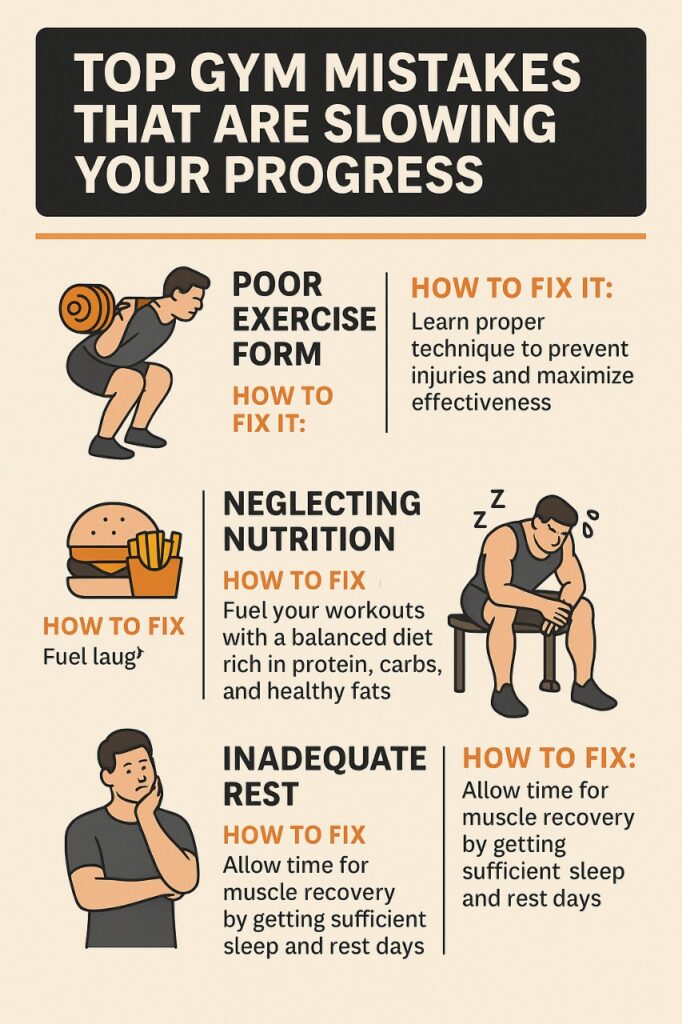
Introduction: Hard Work ≠ Smart Progress
You hit the gym regularly, break a sweat, and push yourself – yet the mirror and the scale don’t seemto agree. The truth? Effort doesn’t guarantee progress.
The human body responds to training through specific, science-driven principles. But when small mistakes compound – in form, nutrition, or recovery – they can stall results or even cause injury.
Let’s break down the most common gym mistakes and the science-backed fixes that can reignite your gains.
1. Lifting Heavy Without Proper Form
Many lifters chase heavier weights too soon – but poor form shifts stress from the muscles to joints
and connective tissues, increasing injury risk.
Why it hurts progress:
Bad form reduces muscle fibre recruitment and limits mechanical tension, both key drivers of hypertrophy (muscle growth).
Research Insight: A 2017 study in the Journal of Strength and Conditioning Research found that correct exercise technique significantly improved muscle activation and reduced injury rates across resistance training programs.
Fix It:
• Master form before load – use lighter weights until your movement pattern is solid.
• Record your lifts or ask a certified trainer for feedback.
• Prioritize compound movements (squats, deadlifts, presses) with strict technique for
maximal efficiency.
2. Ignoring Nutrition – or Eating“Clean” But Not Enough
You can’t out-train a bad diet – but you also can’t grow on an empty plate. Many gym-goers either eat too little (cutting too aggressively) or overeat “healthy” foods without tracking portions.
Why it hurts progress:
Muscle growth and recovery depend on adequate calorie and protein intake. A caloric deficit or protein shortage hinders muscle protein synthesis.
Scientific Fact: Studies in the American Journal of Clinical Nutrition recommend consuming 1.6-2.2g of protein per kilogram of body weight per day for optimal muscle growth and fat loss.
Fix It:
• Track calories for a few weeks to understand your maintenance intake.
• Include a protein source in every meal – eggs, paneer, lentils, chicken, tofu.
• For fat loss, aim for a moderate 15-20% calorie deficit instead of extreme restriction.
3. Skipping Rest and Recovery
The “no days off” mindset is admirable but counterproductive. Muscle doesn’t grow during workouts – it grows during rest and repair.
Why it hurts progress:
Overtraining elevates cortisol, the stress hormone, which increases protein breakdown and impairs muscle recovery.
Research Insight: A 2020 review in Sports Medicine found that athletes training without adequate rest showed up to 30% lower strength gains compared to those following proper recovery cycles.
Fix It:
• Sleep at least 7-9 hours per night – growth hormone peaks during deep sleep.
• Schedule 1-2 rest days per week.
• Add active recovery (yoga, mobility drills, or walking) to promote circulation without strain.
4. No Progressive Overload
Doing the same routine for months might feel safe, but your body adapts fast. Without progression, your muscles have no reason to grow.
Why it hurts progress:
Hypertrophy depends on progressive overload – gradually increasing training intensity, volume, or resistance. Without it, you simply maintain.
Study Spotlight: Research from Frontiers in Physiology (2018) confirmed that increasing load by just 5-10% every few weeks leads to significantly greater strength and size gains.
Fix It:
• Track workouts and aim to increase weight, reps, or sets over time.
• Use variations like tempo training or reduced rest intervals to increase difficulty.
• Reassess your program every 6–8 weeks to ensure continuous adaptation.
5. Neglecting Mind-Muscle Connection
Many people rush through reps without focusing on which muscle they’re working. This weakens activation and reduces overall training quality.
Why it hurts progress:
A strong mind-muscle connection improves motor unit recruitment – meaning your body learns to fire more muscle Fibers during each rep.
Research Fact: A 2016 study in European Journal of Sport Science found that individuals who focused on contracting specific muscles (like the chest during bench press) experienced 23% more growth than those who didn’t.
Fix It:
• Slow down your reps.
• Visualize the target muscle contracting and lengthening.
• Reduce distractions – quality over quantity always wins.
6. Doing Too Much Cardio
Cardio is excellent for heart health – but excessive endurance training can interfere with muscle recovery and strength adaptations.
Why it hurts progress:
Overdoing cardio creates a catabolic environment, increasing energy expenditure and potentially reducing muscle protein synthesis.
Scientific Support: A 2019 meta-analysis in Sports Medicine found that concurrent high-volume cardio
and resistance training led to reduced muscle hypertrophy compared to strength training alone.
Fix It:
• Limit long, high-intensity cardio sessions to 2-3 times per week.
• Prefer HIIT or incline walking post-weight training for fat loss.
• Separate cardio and lifting sessions by at least 6 hours for optimal results.
7. Inconsistent Training and Tracking
If you’re not logging workouts, you’re guessing. Inconsistency prevents measurable progress.
Why it hurts progress:
Training adaptations rely on progressive stress over time. Missing sessions or not tracking data makes it impossible to optimize.
Fix It:
• Maintain a training log or fitness app.
• Stick to a structured program for at least 8-12 weeks.
• Track key lifts (squat, bench, deadlift) to monitor progress objectively.
8. Ignoring Mobility and Warm-Ups
Jumping straight into heavy lifting without warming up tightens joints and increases injury risk.
Why it hurts progress:
Cold muscles have lower elasticity, leading to poor performance and delayed recovery.
Research Backing: The Journal of Strength and Conditioning Research (2020) confirmed that a dynamic warm-up improves strength output by 10-12% in subsequent lifts.
Fix It:
• Spend 10-15 minutes on dynamic stretching and mobility drills.
• Focus on hip openers, shoulder activation, and foam rolling.
• Never skip cool-downs – they reduce soreness and improve flexibility.
Conclusion: Small Fixes, Massive Gains
Your fitness journey doesn’t fail from one big mistake – it’s usually the accumulation of small, unnoticed errors.
When you fix your form, fuel your body right, recover well, and train progressively, your results can accelerate faster than ever.
“Progress is not about doing more – it’s about doing it right.”
In summary:
• Lift with purpose and precision
• Eat for recovery and growth
• Rest like it’s part of training
• Track your progress, not just your effort