
The Power of Indian Nutrition
India’s traditional cuisine isn’t just delicious – it’s nutritionally powerful. Long before protein shakes and imported supplements, our grandmothers were serving protein-rich dals, fibre-packed millets, and healthy fats that supported energy and strength naturally.
Modern nutritional science is finally catching up, confirming that these local, affordable Indian superfoods can rival any “Western” health food when it comes to building muscle and burning fat.
Let’s explore 10 science-backed Indian staples that deserve a permanent spot on your fitness plate
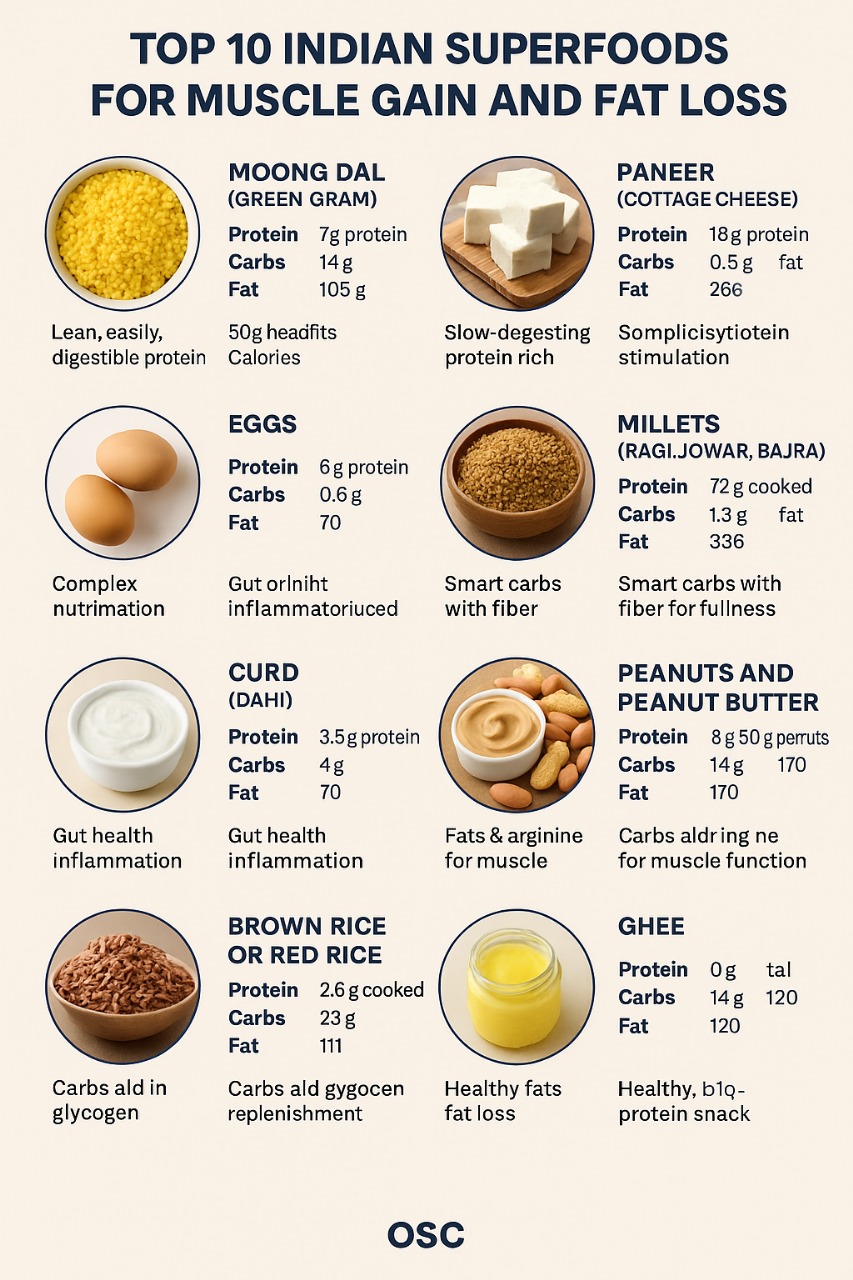
1. Moong Dal (Green Gram) – The Lean Protein Powerhouse
• Macronutrients (per 100g cooked):
o Protein: 7g
o Carbs: 14g
o Fat: 0.4g
o Calories: ~105
Moong dal is one of the most easily digestible plant proteins. It provides essential amino acids needed for muscle recovery and supports gut health with its high fibre content.
Research insight: A 2019 study in the Journal of Food Science and Technology confirmed that legumes like moong dal have a high protein digestibility-corrected amino acid score (PDCAAS), making them ideal for vegetarian athletes.
2. Paneer (Cottage Cheese) – Slow-Digesting Muscle Builder
• Macronutrients (per 100g):
o Protein: 18g
o Fat: 20g
o Carbs: 1.2g
o Calories: ~265
Paneer is rich in casein protein, which digests slowly and provides a steady amino acid release – perfect for muscle repair during sleep.
It’s also high in calcium and vitamin B12, both crucial for bone strength and energy metabolism.
Pro tip: Have grilled paneer or paneer bhurji before bed for overnight muscle recovery.
3. Eggs – The Gold Standard of Protein
• Macronutrients (per large egg):
o Protein: 6g
o Fat: 5g
o Carbs: 0.6g
o Calories: ~70
Eggs provide complete protein, containing all nine essential amino acids. The yolk adds healthy fats and choline – essential for brain and hormone function.
Scientific fact: Studies in the American Journal of Clinical Nutrition show that whole eggs post-workout stimulate muscle protein synthesis more effectively than egg whites alone.
4. Millets (Ragi, Jowar, Bajra) – Smart Carbs with Added Fiber
• Macronutrients (per 100g cooked ragi):
o Carbs: 72g
o Protein: 7g
o Fat: 1.3g
o Fiber: 3.6g
o Calories: ~336
Millets are low-GI (glycemic index) grains, meaning they release energy slowly and keep you fuller for longer. This helps control appetite and maintain blood sugar – key for fat loss.
Rich in iron, magnesium, and calcium, they also enhance oxygen transport and muscle contraction efficiency.
5. Curd (Dahi) – The Gut-Friendly Recovery Food
• Macronutrients (per 100g):
o Protein: 3.5g
o Fat: 4.3g
o Carbs: 4g
o Calories: ~70
Curd provides high-quality protein and probiotics that improve digestion and nutrient absorption – especially calcium and vitamin D.
Research-backed benefit: A 2021 study in Frontiers in Nutrition found that probiotic-rich dairy products enhance muscle recovery and reduce exercise-induced inflammation.
6. Peanuts and Peanut Butter – The Desi Muscle Fuel
• Macronutrients (per 30g peanuts):
o Protein: 8g
o Fat: 14g
o Carbs: 6g
o Calories: ~170
Peanuts are rich in monounsaturated fats and arginine, an amino acid that boosts nitric oxide production for better blood flow to muscles.
They’re perfect as a pre-workout snack or added to smoothies for extra calories when bulking.
Fun fact: Peanuts have nearly the same protein content as almonds, but at a fraction of the cost.
7. Sprouted Legumes (Chana, Moth, Moong) – Enzyme-Activated Protein
• Macronutrients (per 100g sprouted chana):
o Protein: 9g
o Carbs: 27g
o Fat: 2g
o Calories: ~164
Sprouting increases bioavailability of nutrients, enhances amino acid profiles, and reduces antinutrients like phytic acid – making protein absorption more efficient.
They’re ideal for vegetarians aiming for lean muscle gain without heavy digestion load.
8. Ghee – The Healthy Fat That Burns Fat
• Macronutrients (per tablespoon):
o Fat: 14g
o Carbs: 0g
o Protein: 0g
o Calories: ~120
Contrary to myths, pure desi ghee is rich in medium-chain triglycerides (MCTs), which are rapidly used for energy rather than stored as fat.
It also contains conjugated linoleic acid (CLA) – shown in studies to support fat oxidation and lean mass preservation.
Use tip: Add a teaspoon of ghee to dal or rotis for hormonal and joint support during training.
9. Brown Rice or Red Rice – The Carb King for Lean Muscle
• Macronutrients (per 100g cooked):
o Carbs: 23g
o Protein: 2.6g
o Fat: 0.9g
o Calories: ~111
These unrefined rice varieties provide complex carbohydrates, essential for glycogen replenishment after workouts.
They also contain magnesium and manganese, aiding muscle recovery and antioxidant defence.
Post-workout combo: Brown rice + moong dal = a perfect Indian version of a complete protein meal.
10. Makhana (Fox Nuts) – The Light Snack with Heavy Benefits
• Macronutrients (per 100g roasted):
o Protein: 9.7g
o Carbs: 77g
o Fat: 0.1g
o Calories: ~347
Low in fat and high in protein, makhana makes a perfect low-calorie evening snack for fat loss phases.
It’s rich in magnesium and phosphorus, aiding muscle contractions and energy metabolism.
Fitness hack: Mix roasted makhana with nuts and seeds for a homemade trail mix.
Embracing the New Norm: Drought Tolerant Plants
In Los Angeles, where water scarcity is an ever-growing concern, the shift toward drought-tolerant landscaping is more essential than ever. Homeowners and businesses alike are seeking beautiful, sustainable gardens that thrive with minimal water—and drought-resistant plants offer a perfect solution. These resilient species don’t just survive dry conditions—they flourish in them, making them ideal for the Southern California climate.
Beyond Succulents: The Hidden Gems of Drought Resistance
While succulents and cacti are well-known champions of dry gardens, there’s a world of lesser-known plants that offer equal beauty and resilience. Here are a few standout choices:
- California Fuchsia (Epilobium canum)
This vibrant native produces fiery, trumpet-shaped flowers that attract hummingbirds and brighten up any garden. It thrives in full sun and needs little maintenance.
- Texas Ranger (Leucophyllum frutescens)
Known for silvery foliage and purple blooms, this hardy shrub adds striking color and texture. It can bloom several times a year—especially after a rain.
- Bear’s Breeches (Acanthus mollis)
With its bold, sculptural leaves and tall flower spikes, this Mediterranean beauty brings drama to the landscape. It’s drought-tolerant once established.
- Blue Chalksticks (Senecio serpens)
A low-growing succulent with powdery blue-green stems that work beautifully as groundcover or in containers. It’s both tough and visually striking.
Why Drought-Tolerant Landscaping Matters
Choosing drought-resistant plants isn’t just a practical decision—it’s an environmentally responsible one. These landscapes use significantly less water, reducing the strain on local resources, while also requiring minimal maintenance, which helps cut down on fuel use, fertilizers, and emissions. In addition, they support native biodiversity and attract vital pollinators. In a city like Los Angeles, every water-wise choice plays a role in building a healthier, more sustainable urban ecosystem.
“At Evergreen, we believe sustainable landscaping should never compromise beauty. Drought-tolerant gardens are our way of helping Los Angeles thrive—visually and environmentally. Every space we design reflects our passion for smart, stunning, water-wise solutions.”
John Smith, Owner Tweet
Let Evergreen Help You Transform Your Landscape
At Evergreen we specialize in designing and building drought-tolerant landscapes that are as stunning as they are sustainable. Whether you’re adding a few of these hidden gems to an existing garden or starting fresh, our team can help you bring your vision to life—without compromising on beauty or function.
Let’s create a garden that not only survives the heat but thrives in it. Together, we can make Los Angeles greener, one landscape at a time.


I look forward to seeing how these developments will improve service levels and customer satisfaction in the freight industry!