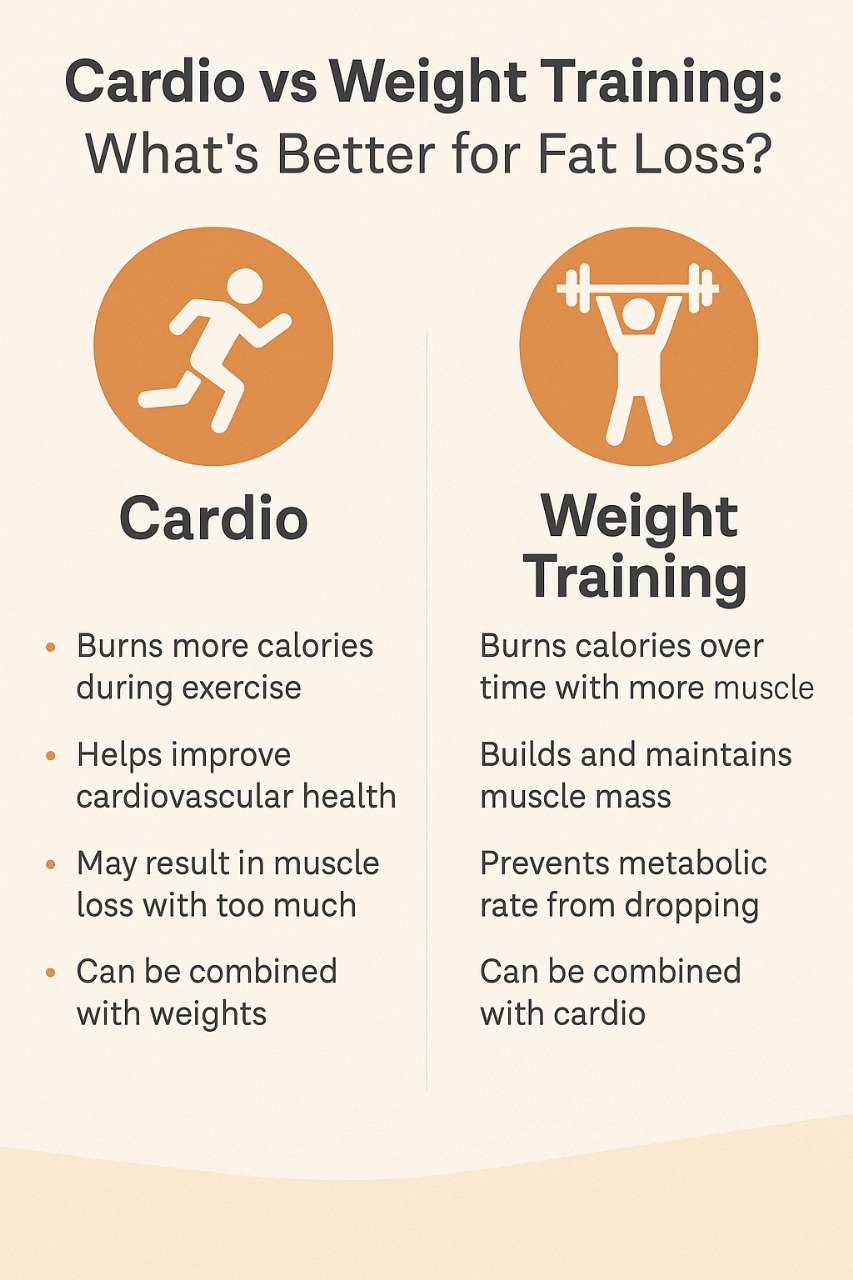
When it comes to burning fat, few debates in the fitness world are as heated as cardio vs weight training. Some swear by hours of running, while others claim lifting heavy is the ultimate fat-burner.
So, what does science really say? Let’s break it down – backed by research – so you can make smarter decisions on your fat-loss journey.
The Science of Fat Loss
Before comparing the two, it’s important to understand how fat loss actually happens. Fat loss occurs when you create a caloric deficit, burning more calories than you consume.
However, how you create that deficit (through cardio, resistance training, or a mix of both) can significantly affect what kind of weight you lose, fat or muscle.
Scientific Note:
According to the National Institutes of Health (NIH, 2019), sustained fat loss is most efficient when combining energy expenditure (exercise) with nutritional control (diet) rather than exercise alone.
Cardio: The Traditional Fat-Burner
1. What It Does
Cardiovascular training – whether it’s running, cycling, swimming, or brisk walking – increases your heart rate, improves endurance, and directly burns calories during the session.
2. Calorie Expenditure
• A 70 kg person burns approximately:
o 600 kcal/hour running at 8 km/h
o 400 kcal/hour cycling moderately
o 300 kcal/hour brisk walking
Research Insight:
A study in The Journal of Applied Physiology (2012) found that participants who performed moderate-intensity cardio 5 days a week lost significant fat mass over 12 weeks, especially when combined with calorie restriction.
3. Pros
• Quick calorie burn
• Improves heart and lung health
• Enhances recovery between strength sessions
4. Cons
• May lead to muscle loss if overdone or paired with low protein intake
• Metabolic rate returns to baseline soon after exercise (minimal “afterburn” effect)
Scientific Support:
A 2013 meta-analysis in Sports Medicine showed that steady-state cardio improves fat oxidation, but Long-term exclusive cardio programs can reduce lean mass without resistance training support.
Weight Training: The Metabolic Multiplier
1. What It Does
Resistance training – lifting weights, bodyweight workouts, or resistance bands — builds lean muscle
tissue, which raises basal metabolic rate (BMR). This means you burn more calories even at rest.
2. Muscle = Metabolism
Every kilogram of muscle burns about 13-15 kcal per day, whereas a kilogram of fat burns only 4-5 kcal.
Over time, more muscle means a faster metabolism and greater long-term fat-burning capacity.
Scientific Insight:
A study in Obesity (2017) found that individuals who engaged in resistance training while dieting
preserved more lean mass and lost more fat than those who did only cardio.
3. Afterburn Effect (EPOC)
Post-weight training, your body continues to burn calories due to Excess Post-Exercise Oxygen Consumption (EPOC) – the “afterburn effect.”
This elevated metabolism can last up to 24-48 hours after training.
Research Evidence:
The European Journal of Applied Physiology (2015) demonstrated that high-intensity resistance training produced greater EPOC than steady-state cardio of the same duration.
4. Pros
• Builds and preserves lean muscle mass
• Increases resting metabolism
• Improves insulin sensitivity and hormone balance
• Enhances long-term fat oxidation
5. Cons
• Burns fewer calories during the workout compared to cardio
• Requires proper form and progression to avoid injury
Combining Cardio & Strength: The Optimal Fat-Loss Strategy
Weight Training: The Metabolic Multiplier
1. What It Does
Resistance training – lifting weights, bodyweight workouts, or resistance bands — builds lean muscle tissue, which raises basal metabolic rate (BMR). This means you burn more calories even at rest.
2. Muscle = Metabolism
Every kilogram of muscle burns about 13-15 kcal per day, whereas a kilogram of fat burns only 4-5 kcal.
Over time, more muscle means a faster metabolism and greater long-term fat-burning capacity.
Scientific Insight:
A study in Obesity (2017) found that individuals who engaged in resistance training while dieting preserved more lean mass and lost more fat than those who did only cardio.
3. Afterburn Effect (EPOC)
Post-weight training, your body continues to burn calories due to Excess Post-Exercise Oxygen Consumption (EPOC) – the “afterburn effect.”
This elevated metabolism can last up to 24-48 hours after training.
Research Evidence:
The European Journal of Applied Physiology (2015) demonstrated that high-intensity resistance
training produced greater EPOC than steady-state cardio of the same duration.
4. Pros
• Builds and preserves lean muscle mass
• Increases resting metabolism
• Improves insulin sensitivity and hormone balance
• Enhances long-term fat oxidation
5. Cons
• Burns fewer calories during the workout compared to cardio
• Requires proper form and progression to avoid injury
Combining Cardio & Strength: The Optimal Fat-Loss Strategy
Rather than choosing one over the other, research consistently supports a hybrid approach.
Scientific Consensus:
A 2018 study published in the Journal of Sports Science & Medicine concluded that combining aerobic and resistance training leads to greater reductions in fat mass and improvements in cardiovascular fitness compared to either alone.
Optimal Weekly Mix:
• 3-4 sessions of weight training (full-body or split)
• 2-3 sessions of cardio (HIIT or steady-state)
• 1-2 active rest days (walking, yoga, stretching)
HIIT (High-Intensity Interval Training) – a cardio method involving short bursts of intense effort – burns fat efficiently and can preserve muscle mass when paired with adequate protein intake.
Supporting Evidence:
A Harvard School of Public Health (2021) review found that HIIT workouts improved fat loss and cardiovascular performance while maintaining lean muscle better than low-intensity cardio alone.
The Role of Nutrition
Exercise without nutrition alignment is like rowing with one oar – you’ll go in circles.
To optimize fat loss:
• Maintain a moderate calorie deficit (15-20%)
• Prioritize 1.6-2.2 g of protein per kg body weight
• Choose nutrient-dense carbs and healthy fats
• Stay hydrated and sleep 7-8 hours daily
Scientific Correlation:
According to The American Journal of Clinical Nutrition (2020), protein-rich diets combined with resistance training resulted in 38% more fat loss and double the lean mass gain compared to lowprotein diets.
The Verdict
| Aspect | Cardio | Weight Training |
|---|---|---|
| Calories Burned (per session) | High | Moderate |
| Muscle Preservation | Low | High |
| Metabolic Boost (Afterburn) | Minimal | High |
| Heart Health | Excellent | Moderate |
| Long-Term Fat Loss | Moderate | Excellent |
| Best For | Beginners / Endurance | Sustainable Fat Loss & Toning |
Best Strategy: Combine both for maximum effect.
Use cardio to burn calories fast and weights to build a body that keeps burning them all day.
Final Takeaway
If your goal is lasting fat loss – not just dropping numbers on the scale – weight training should be your foundation, complemented by strategic cardio.
By combining both intelligently, supported by proper nutrition, hydration, and rest, you’ll build not only a leaner physique but also a stronger, more efficient body.
I look forward to seeing how these developments will improve service levels and customer satisfaction in the freight industry!