
The Modern Dilemma: Timing vs Balance
In the quest for better health and physique, two dietary philosophies dominate the conversation: Intermittent Fasting (IF) and the Balanced Diet approach.
While intermittent fasting focuses on when you eat, a balanced diet emphasizes what and how much you eat. Both have passionate advocates – and both are supported by scientific evidence.
But when it comes to fat loss, muscle gain, and metabolic health, which strategy truly delivers the edge? Let’s explore the science.
What Is Intermittent Fasting (IF)?
Intermittent fasting involves cycling between eating and fasting periods – popular formats include:
• 16:8 method – 16 hours of fasting, 8 hours of eating
• 5:2 method – 2 low-calorie days per week
• Alternate-day fasting – fasting every other day
The core idea: by restricting eating windows, you reduce calorie intake naturally and enhance metabolic efficiency.
A 2020 study published in Cell Metabolism found that participants following time-restricted eating (8-hour window) experienced a 10% reduction in calorie intake and improved insulin sensitivity – even without consciously changing food quality.
What Is a Balanced Diet?
A balanced diet focuses on consuming the right proportions of macronutrients (proteins, carbs, fats) and micronutrients (vitamins, minerals, fibre) spread throughout the day.
Rather than restricting meal timing, it prioritizes nutrient diversity, portion control, and consistency.
The World Health Organization (WHO) defines a balanced diet as one that “provides the necessary nutrients to maintain overall health, metabolic function, and energy balance.”
When executed correctly, it prevents energy crashes, supports steady fat loss, and sustains muscle mass – without the rigidity of fasting windows.
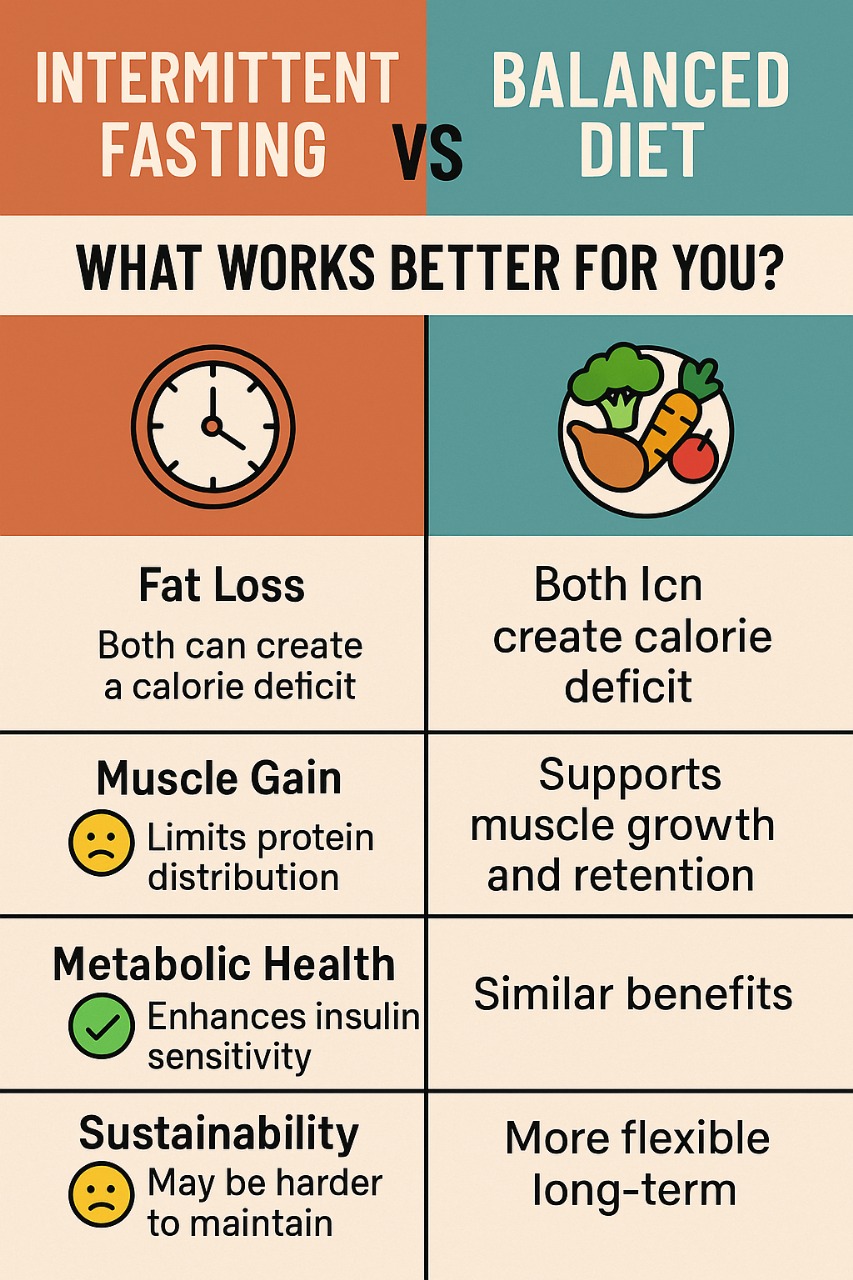
1. Fat Loss: Calorie Deficit Rules All
Verdict: It’s a tie – both work when calories are controlled.
Multiple studies, including a 2022 meta-analysis in JAMA Network Open, concluded that intermittent fasting and continuous calorie restriction result in similar fat loss outcomes when calorie intake is equal.
However, adherence often differs:
• Intermittent fasting helps people eat less naturally, since meal frequency is reduced.
• Balanced diets provide flexibility and sustainability, making them easier to maintain long-term.
Science-backed insight:
Fat loss depends primarily on calorie deficit – how you achieve it (fasting or balanced meals) matters less than whether you sustain it.
2. Muscle Gain and Retention: The Balanced Diet Advantage
Verdict: A Balanced diet outperforms intermittent fasting for muscle preservation.
Muscle growth requires:
1. Sufficient protein intake, and
2. Regular protein distribution across the day.
A 2018 study in the Journal of Translational Medicine found that individuals who consumed protein every 3-4 hours stimulated 40% more muscle protein synthesis than those who ate the same amount of protein in one or two sittings – as often occurs with IF.
While intermittent fasting can support muscle gain if total protein is met, the restricted eating window makes it harder to distribute protein evenly, potentially limiting muscle-building efficiency.
3. Metabolic Health: IF Shows Unique Benefits
Verdict: Intermittent fasting slightly edges out for metabolic flexibility.
Research published in The New England Journal of Medicine (2019) demonstrated that fasting
triggers autophagy – a cellular “cleanup” process linked to improved insulin sensitivity, reduced
inflammation, and protection against metabolic diseases.
Additionally, intermittent fasting can improve:
• Blood sugar regulation
• Lipid profile (cholesterol, triglycerides)
• Resting insulin levels
However, these benefits are most pronounced in overweight or insulin-resistant individuals. For metabolically healthy people, a balanced diet achieves similar outcomes with more flexibility.
4. Hormonal and Energy Impact
Intermittent Fasting:
• May lower ghrelin (the hunger hormone) over time, reducing appetite.
• Can temporarily elevate cortisol (stress hormone), particularly during prolonged fasts.
• Some women report menstrual cycle disruptions with aggressive fasting schedules.
Balanced Diet:
• Supports steady energy levels due to consistent glucose supply.
• Maintains hormonal equilibrium, especially for individuals with high training loads or stress levels.
Bottom Line:
If your goal involves high-performance training, muscle gain, or hormonal balance, the balanced diet tends to be more supportive.
5. Longevity and Lifestyle Sustainability
Verdict: Balanced diet wins long-term – IF suits short-term metabolic resets.
While intermittent fasting has intriguing longevity links in animal studies, human data remains inconclusive.
The National Institute on Aging notes that while fasting may promote “cellular repair mechanisms,” its long-term safety and adherence rates vary.
In contrast, a balanced diet grounded in whole foods, lean proteins, healthy fats, and moderate carbohydrates has decades of evidence supporting longevity, heart health, and cognitive stability.
Choosing What Works Best for You
| Goal | Best Approach | Why |
|---|---|---|
| Fat Loss | Either | Both create calorie deficit effectively |
| Muscle Gain | Balanced Diet | Supports protein distribution and energy levels |
| Metabolic Health | Intermittent Fasting | Enhances insulin sensitivity and autophagy |
| Long-Term Sustainability | Balanced Diet | Easier to maintain psychologically and socially |
The Takeaway
Both intermittent fasting and a balanced diet are powerful tools – but their success depends on your goals, lifestyle, and ability to stick with them.
Choose Intermittent Fasting if:
• You prefer simplicity and fewer meals
• You want to improve insulin sensitivity
• You don’t struggle with energy dips or intense training
Choose a Balanced Diet if:
• You train regularly or aim to build muscle
• You need stable energy throughout the day
• You prefer a flexible, long-term approach
Science shows there’s no single “best” diet – only the one that works best for you
I look forward to seeing how these developments will improve service levels and customer satisfaction in the freight industry!